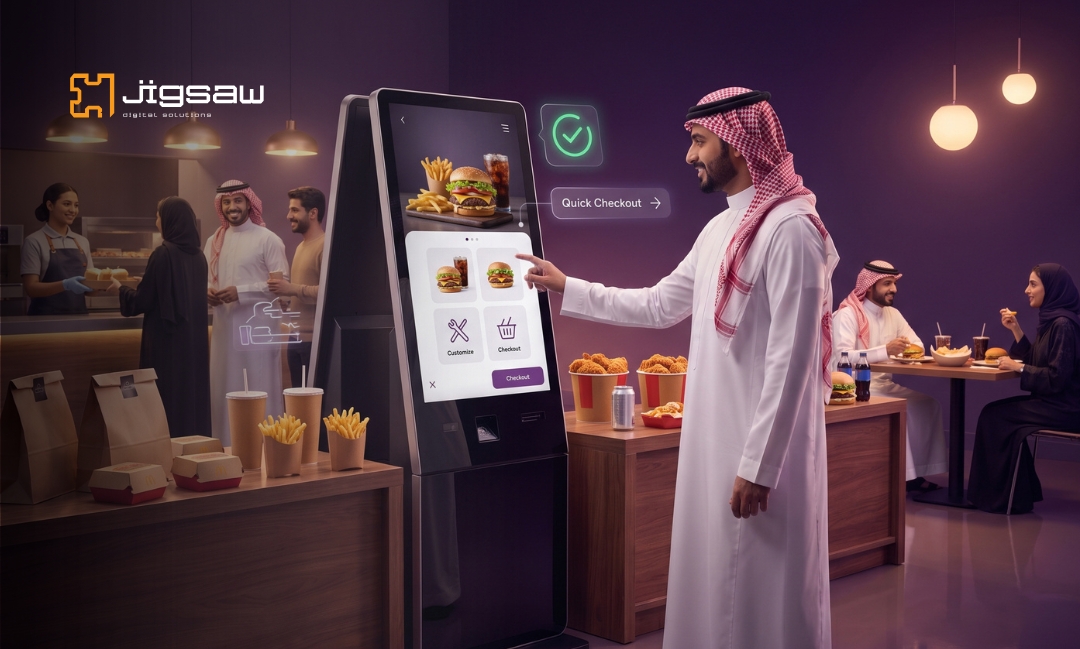
The Food and Beverage (F&B) sector across the globe, and particularly within the rapidly advancing market of Saudi Arabia, is undergoing a profound digital transformation. Consumers are no longer just seeking speed; they demand control and personalization over their ordering experience. At the heart of this evolution stand Self-Service Kiosks—advanced interactive platforms that have moved beyond being simple queue-reducers to become the ultimate Silent Sales Agent, operating with tireless efficiency around the clock.
The core objective of investing in a Touchscreen Kiosk Ordering Solution now extends far beyond mere operational efficiency. The true strategic goal is maximizing the Average Order Value (AOV) per transaction. A kiosk's ability to interact with a customer, free from the time pressure of a human employee, creates an unparalleled opportunity to deploy sophisticated upselling and cross-selling tactics with surgical precision.
This article outlines three crucial and proven strategies that restaurant managers and brand owners can implement to ensure their Self-Service Kiosks become a fundamental engine for revenue growth.
1. Strategy One: Engineering the Digital Menu for Targeted Upselling
In a traditional ordering setup, upselling is a spontaneous, often random process reliant on the individual employee’s memory and skill. Conversely, within the environment of a Self-Service Kiosk, the menu transforms into a carefully engineered marketing tool designed to maximize every possible opportunity for advanced selling.
A. Designing the Mandatory, Enticing Customer Journey
The kiosk screens must be intentionally designed to guide and entice the customer along a logical, high-value path. Every single step in the ordering process must open a strategic window for upselling:
- Pre-Checkout Prompts (The Final Push): This is the most effective screen. Just before the customer clicks “Complete Payment,” a persistent pop-up must appear, intelligently suggesting highly relevant items based on their primary order. If the customer orders a burger, the Restaurant Self-Ordering Kiosk Riyadh should ask: “Would you like to double the patty or add crispy bacon for a minimal charge?” The suggested addition must be visually compelling, enticing, and priced to feel negligible against the overall order cost.
- Automatic Sizing Optimization: The base, "regular" size should not be the default display option. Instead, the medium or large size upgrade should be prominently featured as the "Best Value." This tactic leverages the customer's tendency to select the option perceived as offering the most value, subtly encouraging them to spend more. This advanced design is a hallmark of a Modern Kiosk Design for Retail Cafés.
- Leveraging Visuals for Impulse: The quality of the imagery is the single most important component on the kiosk. Images of add-ons and side items must be high-resolution, professionally lit, and appetizing. This directly stimulates the visual response and the immediate impulse to purchase, a powerful motivator that linear verbal communication cannot match.
B. Employing Pricing Psychology and Smart Product Bundling
To effectively maximize the AOV, smart pricing tactics must be strategically deployed within the kiosk interface:
- Communicating Bundled Value: Instead of selling a sandwich, fries, and a drink separately, they should be presented as a "Signature Meal Bundle" or "Value Combo" at an aggregated price. This persuades the customer that they are receiving a discount or added value for completing the meal, thus effectively increasing their average spend.
- Highlighting the Savings: When comparing the price of the bundled product (the combo) to the individual item prices, the kiosk must clearly showcase the precise monetary savings the customer is achieving, fostering a feeling of smart and deliberate purchasing.
- The Swap-and-Upgrade Mechanism: If a customer selects a standard beverage, the kiosk should prominently offer a "Swap" or "Upgrade" to a specialty coffee or fresh juice for a small, defined extra cost, framing the decision as an optional enhancement rather than an entirely new, separate purchase.
2. Strategy Two: Personalized Selling Driven by Customer Behavior and Data
The true intelligence of a modern Self-Service Kiosk lies in its ability to move beyond static, generalized offers. When integrated with an advanced loyalty or predictive system, the kiosk acts as a Personalized Sales Expert who knows the customer’s purchase history and preferences.
A. Interacting with Customer Lifetime Value (CLV) Data
The modern Touchscreen Kiosk Ordering Solution finally allows brands to utilize Customer Lifetime Value (CLV) data directly in the immediate sales process:
- Identifying Deviant Behavior: If a loyal customer, identified through their Kiosk with Receipt Printer & QR Scanner loyalty scan, typically orders a specific item (e.g., a vegetarian dish), the kiosk should, on their next visit, only prominently feature new vegetarian add-ons or modifications, avoiding irrelevant options and wasted screen time.
- Instant Loyalty Activation: If a high-value loyal customer is placing a smaller-than-usual order, the kiosk should intervene with a personalized, conditional offer (e.g., "As a valued member, get your favorite coffee free when you add a dessert to this order"). This instantaneously incentivizes them to increase the current order value to earn the reward. This capability is key to driving Customer Loyalty via Kiosk.
- Contextual Offer Modification: The kiosk adjusts its suggestions based on the immediate context. During morning hours, it prominently displays breakfast sides. If the weather is cold, it automatically prioritizes hot soups and specialty warm beverages. This Real-Time Contextual Analysis significantly boosts the customer's response rate to the suggestions.
B. Cross-Selling Based on Collective Memory
Smart kiosk solutions leverage the power of aggregated sales data to identify strong product affinities:
- "What Others Ordered" Suggestions: Immediately after the customer adds their main dish, the kiosk should display a side panel with a message like: "Customers who ordered this item also added [Name of Side Dish] 75% of the time." This strategy encourages the customer to purchase based on social proof and the implied wisdom of the crowd.
- Order Completion Prompts: If a customer selects a main course but forgets a beverage or side item, the kiosk should issue a direct, gently phrased prompt ("Did you remember your drink?" or "Complete your meal with a side of fries"), ensuring the order is finished to its optimal minimum value. These insights are powered by the Kiosk Analytics Dashboard.
3. Strategy Three: Leveraging Unpressured Time for Frictionless Experience
The most undervalued aspect of the Self-Service Kiosk is its ability to grant the customer complete control over the pace of their transaction. This unpressured time, which is no longer spent waiting in a long line, becomes a precious window to persuade the customer to increase their spending without feeling rushed or pressured.
A. Eliminating Human Pressure and Time Constraints
When dealing with a human cashier, customers often feel rushed to complete their orders quickly, fearing they will hold up the line or annoy the staff. This psychological pressure severely limits the likelihood of the customer considering add-ons. Self-Service Kiosk durability & performance eliminates this anxiety entirely:
- Customer-Controlled Pace: The customer can leisurely browse the entire menu, compare options, and review high-quality images of upgrades and add-ons without feeling rushed. This dramatically increases the probability of them discovering and adding extra items to their order.
- Cost Transparency and Control: The customer can monitor the exact running total of their order with every addition or upgrade. This provides a sense of transparency and financial control, which, paradoxically, often makes them more willing to make thoughtful, deliberate purchases. This is a crucial function of the Kiosk Integration with POS & Inventory.
B. Employing Gamification and Behavioral Nudging
To make the ordering process enjoyable and to incentivize higher spending, elements of engagement and behavioral nudging can be seamlessly integrated into the interface:
- The Reward Progress Bar: If the customer is a member of the loyalty program, a visual progress bar should appear, showing: "Just $2 more added to this order will earn you enough points for a free dessert on your next visit!" This creates an instantaneous incentive to increase the current bill value to secure a guaranteed future gain.
- Daily Challenge Rewards: Displaying a time-sensitive, rotating daily challenge (e.g., "Add the new appetizer today and get double loyalty points!"). This limited-time engagement creates a sense of scarcity and motivates an immediate purchase.
- Positive Reinforcement: Upon adding a high-value upsell item, the kiosk should flash a brief, positive message (e.g., "Excellent choice! That item pairs perfectly with your meal"). This simple positive reinforcement builds customer confidence in their decision and subtly encourages further intentional spending.
Self-Service Kiosks, particularly those designed for the sophisticated demands of the Saudi market—such as the Fast Food Kiosk Self Ordering systems—have proven to be a high-return strategic investment. Their function is not limited to saving customer time and ensuring order accuracy; they are advanced sales tools that use Real-Time Analysis and consumer psychology to transform every single order into a targeted opportunity for maximizing revenue.
The seamless integration of the POS Kiosk Solution Saudi Arabia with backend inventory and advanced loyalty programs ensures that the device is capable of remembering, suggesting, and gently motivating the customer to increase their spend smartly and politely. For restaurant managers, adopting these three strategies is the guarantee that the kiosk transforms from a mere touchscreen into the most efficient and low-cost employee focused entirely on achieving the highest possible Average Order Value. The market demands efficiency, and the modern Self-Service Kiosk for Restaurants Riyadh provides the technology to meet that demand while significantly boosting the bottom line.





.avif)
.avif)
.avif)